

Last updated: October 2026
Product and pricing information last verified October 11, 2026.
On this page
The best Workiz alternative depends less on which competitor has the longest feature list and more on what you actually want to change about Workiz. Workiz is unusually communication-centered for field service software. Its current platform combines core FSM workflows such as scheduling, jobs, estimates, invoicing, client management, reporting, and recurring jobs with phone and messaging functionality, while products such as Genius Phone, Genius Answering, and Genius Marketing extend the communication, AI, and marketing side of the ecosystem. Its current Standard, Pro, and Ultimate plans all use Request Pricing, with automation allowances and more advanced operational features increasing by tier. (Workiz)
That creates several different reasons to look elsewhere.
One business may want published pricing before speaking to sales. Another may be trying to reduce the cost pressure of adding more employees. A third may want simpler operations, deeper customization, or substantially more operational control.
The useful question is therefore: Why are you considering leaving or avoiding Workiz, and which alternative fixes that mismatch without introducing a worse one?
Workiz Alternatives at a Glance
| Alternative | Best For | Pricing Model | Main Trade-Off |
|---|---|---|---|
| Jobber | Best overall for simpler operations | Published tiered plans | Communications and AI are packaged differently from Workiz |
| Housecall Pro | Residential growth workflows | Published tiered plans | Feature packaging varies by plan and configuration |
| Service Fusion | Teams reducing user-count pressure | Flat plans with unlimited users | Fixed base subscription may offer less advantage to a very small team |
| FieldPulse | Configurable workflows + communications | Custom seat-based quote | Does not solve pricing-transparency concerns |
| ServiceM8 | Small teams wanting job-volume pricing | Published job-credit plans | Scaling pressure moves from users to job volume |
| Kickserv | Smaller QuickBooks-centered teams | Published bundled-user plans | Less Workiz-style communications/AI depth |
| ServiceTitan | Deeper operational complexity | Quote-based per-technician pricing | More implementation and administration complexity |
Quick verdict: Jobber is the strongest general alternative when the priority is a more straightforward FSM workflow with published pricing. Housecall Pro is especially relevant for residential home-service companies that want a public buying path plus deeper sales and customer-growth tools. Service Fusion changes the economics for teams adding more employee logins, while ServiceM8 shifts the constraint toward monthly job volume instead. FieldPulse deserves particular attention when configuration and integrated communications both matter. ServiceTitan is the more relevant move when the problem is operational depth rather than simplicity or pricing transparency. None of those differences mean everyone should leave Workiz.
Why Consider a Workiz Alternative?
There are four practical reasons a business may look beyond Workiz.
The first is pricing visibility. Workiz currently lists Standard, Pro, and Ultimate but uses Request Pricing for all three. Its public page also shows that automation allowances increase from five on Standard to 10 on Pro and 30 on Ultimate, while capabilities such as service plans, sales proposals, inventory, multi-day jobs, purchase orders, and open API access sit higher in the structure.
For a buyer who wants to estimate the likely software commitment before talking to sales, that may be inconvenient. Our detailed Workiz pricing guide covers the current package structure separately.
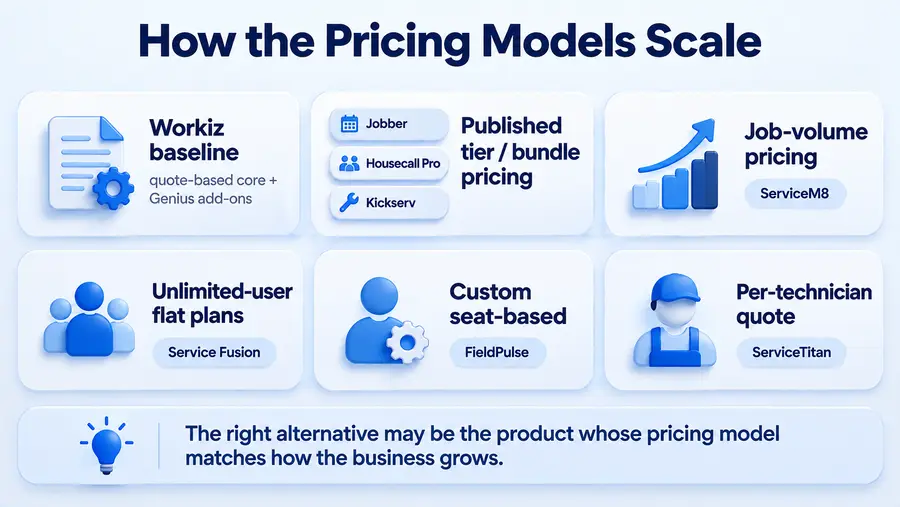
The second reason is the scaling model. Different Workiz competitors charge in very different ways. Service Fusion uses flat plan pricing with unlimited users. ServiceM8’s paid plans include unlimited users but cap monthly new jobs. Jobber, Housecall Pro, and Kickserv use published plan structures with different user allowances. FieldPulse is seat-based and custom quoted, while ServiceTitan uses per-technician Request Pricing.
No one pricing model is automatically cheaper. The important question is what changes when the business grows: people, job volume, required features, or operating complexity. A third reason is feature packaging. A company may like Workiz but discover that the workflow it needs sits in a higher tier or a separate Genius product. Another vendor may package the same business problem more conveniently, even if its overall feature list is not larger.
Finally, communications may either be Workiz’s strongest reason to stay or a reason to simplify. Workiz’s current ecosystem places calling, messaging, AI answering, marketing, and FSM data close together. Genius Phone, Genius Answering, and Genius Marketing are explicitly presented as separate products/add-ons rather than reasons to assume every communication capability comes with the base subscription.
If that communication layer is central to daily operations, switching is not just a scheduler replacement. If it is secondary, another FSM may offer a cleaner fit.
The Best Workiz Alternatives
Jobber — Best Overall for Simpler Operations
Jobber is the strongest general Workiz alternative for a small home-service business that wants a mature request → quote → job → invoice → payment workflow with public plan pricing. Its current structure uses Core, Connect, Grow, and Plus, with several billing and commitment options rather than a Request Pricing model for normal small-business plans. Jobber also has meaningful communication and growth functionality of its own: two-way texting, automated customer messages, custom automations, Marketing Suite, and an AI-powered Receptionist are all part of the current ecosystem. So the comparison is not “Workiz has communications and AI; Jobber does not.” Choose Jobber when you want more upfront pricing visibility and a relatively straightforward general FSM operating model. The trade-off is that communications, AI, automation, and marketing are organized and packaged differently from Workiz rather than reproducing the same communication-centered stack.
For a closer look at how these differences affect pricing, dispatch, AI communications, and contractual flexibility, read our Jobber vs Workiz comparison.
Housecall Pro — Best for Residential Growth Workflows
Housecall Pro is a strong Workiz alternative for residential home-service businesses that want scheduling and dispatch alongside a more visible buying path and a substantial sales/customer-growth toolkit. Its current public structure uses Basic, Essentials, and MAX, with visible pricing states and a 14-day trial that does not require a credit card. Higher configurations include capabilities such as Routes, flat-rate pricing, a Sales Proposal Tool, recurring Service Plans, route optimization, and broader support/onboarding options.
That makes Housecall Pro attractive when the buyer wants to inspect the likely software commitment before a sales conversation while still keeping meaningful residential service, sales, routing, and recurring-revenue workflows in one system.
The main caveat is packaging. Housecall Pro’s current pricing experience can change depending on billing cycle, user count, industry, promotion, or configuration, so one rendered package should not be treated as universal.
For a closer buying decision between these two platforms, our Housecall Pro vs Workiz comparison covers phone workflows, pricing transparency, plan limitations, and contract commitments.
Service Fusion — Best for Unlimited Users
Service Fusion is most relevant when adding more people to the software is changing the economics.
Its current Starter, Plus, and Pro plans all include unlimited users. Core workflows include customer management, estimates and jobs, scheduling and dispatch, QuickBooks integration, invoicing and payments, project management, reporting, and text alerts. Higher plans add capabilities such as inventory, job costing, integrated voice/text, API access, custom documents, customer portal functionality, and recurring/progress billing.
That creates a fundamentally different scaling model from software where every additional technician or office user can change the subscription. But unlimited users should not be mistaken for unlimited usage or automatically better economics. Because Service Fusion uses a flat base subscription regardless of ordinary user count, a solo operator or very small team may not benefit enough from the unlimited-user model to justify that structure. And because Workiz pricing is currently quote-based, it would be inaccurate to claim Service Fusion is always cheaper.
Choose it when user-count pressure is the problem—not simply because “unlimited” sounds attractive.
FieldPulse — Best for Configurable Workflows
FieldPulse is the strongest alternative in this shortlist when the reason for leaving Workiz is workflow configuration rather than price transparency. Its current pricing page describes the platform as seat-based, with pricing customized around team size and access needs. It also emphasizes configurable workflows and lists premium capabilities such as Custom Forms, Engage, Operator AI, and Chat AI.
Engage is particularly relevant to a Workiz buyer because FieldPulse positions it as a built-in phone system where calls, texts, and voicemails can be linked to customer records. Operator AI and Chat AI extend the communications/AI side of the platform, although they should not be assumed to replicate Workiz Genius feature-for-feature. That makes FieldPulse an important shortlist candidate when the business wants more process customization without abandoning the idea of integrated communications.
The trade-off is clear: FieldPulse does not solve the “I want visible pricing before I talk to sales” problem. Exact seat and premium-product requirements need a custom quote.
ServiceM8 — Best for Job-Volume Pricing
ServiceM8 changes the scaling question from how many people need access to how many new jobs the business creates. Its current US pricing starts with a Free plan for one user and 30 monthly jobs. Paid Starter, Growing, Premium, and Premium Plus plans all allow unlimited users while increasing the included new-job allowance. The current published tiers cover 50, 150, 500, and 1,500+ new jobs per month respectively.
Core functionality includes scheduling, job cards, quotes, invoices, client/job history, payments, accounting integrations, and recurring work. That can be attractive for a solo operator or small service team that wants transparent pricing without ordinary per-seat pressure. The trade-off is that the ceiling does not disappear—it moves. As the company completes more work, job-credit allowances become the scaling variable.
ServiceM8 is therefore strongest for relatively straightforward operations where monthly job volume is easier to predict than user growth.
Kickserv — Best for QuickBooks-Centered Small Teams
Kickserv is a practical Workiz alternative for smaller teams that want published user bundles and straightforward QuickBooks integration. Its current Start, Run, and Scale plans include five, 10, and 20 users respectively, with published pricing and 30-day trials. QuickBooks Online integration is available on Start, while Run adds capabilities including dispatch mapping, GPS check-ins, custom fields, custom reporting, and optional QuickBooks Desktop integration.
That makes budgeting easier to inspect before purchase than Workiz’s current Request Pricing approach. Kickserv is especially relevant where customer/job management, dispatch, time/expense tracking, reporting, and accounting connectivity matter more than maintaining a Workiz-style communications and AI ecosystem. The trade-off is exactly that difference: it should not be presented as a like-for-like replacement for Genius Phone, Genius Answering, and Genius Marketing.
Kickserv also still has a Flex option, but it is not an unconditional permanent free plan; its subscription waiver depends on meeting its payment-processing requirement.
ServiceTitan — Best for Deeper Operational Complexity
ServiceTitan is the least appropriate alternative on this list when the buyer simply wants something easier or more transparent than Workiz. It becomes relevant when the business wants more operational structure. The current platform uses Starter, Essentials, and The Works with per-technician Request Pricing rather than public dollar pricing. The base platform includes scheduling, dispatching, call booking, invoicing, and Pricebook functionality, with deeper package capabilities around mobile estimates, payroll, reporting, commissions, memberships, and related administration.
ServiceTitan can make more sense when the Workiz mismatch involves capacity control, stricter pricing governance, more interconnected reporting, recurring-revenue administration, payroll/commission structures, or commercial operational complexity. That depth creates a new trade-off: a more structured buying, configuration, and administration process. It is not a “graduate to ServiceTitan at X technicians” recommendation. A smaller complex company can have a stronger use case than a larger business whose current workflows remain straightforward.
Choose by Your Switching Reason
The most useful shortlist changes depending on what you actually want Workiz to do differently. If you want published pricing, start with Jobber, Housecall Pro, ServiceM8, and Kickserv. Each exposes a meaningful public pricing structure that lets you model the likely subscription before a sales conversation. That does not mean any of them is automatically cheaper than Workiz; Workiz’s current quote is unknown until you obtain one.
If user count is changing the economics, compare Service Fusion with ServiceM8. Service Fusion keeps all plans unlimited-user and charges a flat plan rate, while ServiceM8’s paid tiers also allow unlimited users but shift the constraint to monthly new-job allowances. The key comparison is therefore fixed account cost versus job-volume scaling—not simply “unlimited users.”
If you need more workflow configuration, FieldPulse is the most relevant candidate. Its current model is explicitly seat-based and customized to the team’s requirements, with configurable workflow and premium-product options. That solves a different problem from pricing transparency.
If phone and AI are core to the business, switching deserves more caution. Workiz may still be the stronger fit if its communication-centered structure is working well. Our full Workiz review covers that product fit more broadly.
FieldPulse should still be evaluated because Engage, Operator AI, and Chat AI preserve the idea of communications and AI living close to the FSM. Jobber should not be dismissed either: it currently supports two-way messaging, automated communication, AI Receptionist, marketing, and custom automation, although the packaging differs.
If the real problem is deeper operational control, ServiceTitan becomes the most relevant candidate. Capacity, pricing governance, reporting, recurring revenue, and commercial complexity are better reasons to consider it than a generic employee-count threshold.

What to Check Before Switching
Changing FSM software affects more than the calendar. Before cancelling Workiz, the business should map what must move, what can be rebuilt, what needs to remain accessible during cutover, and which communication or payment workflows could break.
At minimum, verify how each candidate handles:
- customer records;
- open jobs;
- future appointments;
- estimates;
- unpaid invoices;
- attachments and job history;
- Price Book data;
- recurring work or service plans;
- inventory;
- custom fields and automations;
- QuickBooks synchronization and cutover;
- phone numbers and number porting;
- call recordings;
- messaging history;
- active deposits or payment schedules;
- staff permissions and training.
This matters especially for a Workiz user because phone, messaging, AI answering, customer records, and operational data may be more interconnected than they would be in a scheduler-only system. Do not assume every alternative can perform a full Workiz import. A vendor may support customer and job migration while requiring service plans, automation logic, phone history, or custom fields to be recreated manually. Phone-number porting may also follow a separate process from software data migration.
The safest cutover rule is simple: Do not cancel Workiz until you know what data, communications, recurring billing, and open work will survive the migration—and how the old and new systems will overlap during the transition.
FAQs
What Is the Best Alternative to Workiz?
Jobber is the strongest general starting point if the goal is a simpler mainstream FSM workflow with public pricing. Housecall Pro is stronger for residential growth workflows; Service Fusion is notable for unlimited-user economics; FieldPulse is the most relevant option when configuration and an alternative integrated communications stack both matter; ServiceM8 changes scaling toward job volume; and ServiceTitan is better suited to deeper operational complexity. There is no universal winner because each option fixes a different potential Workiz mismatch.
Is There a Free Workiz Alternative?
Yes. ServiceM8 currently offers a permanent Free plan for one user with 30 included jobs per month, plus the ability to earn additional Bonus Jobs through eligible card-payment activity.
That does not make it equivalent to the full paid Workiz platform. The user limit, job model, communications stack, and broader workflow depth are different. Workiz itself currently offers a seven-day trial with no credit card rather than a permanent free plan.
Which Alternative Has Unlimited Users?
Service Fusion currently includes unlimited users on Starter, Plus, and Pro.
ServiceM8’s paid plans also allow unlimited users, but they scale through monthly job allowances instead.
That distinction matters because unlimited users does not mean unlimited jobs, features, or usage. The pricing constraint has simply moved somewhere else.
Is Workiz Still Worth Considering?
Yes. Workiz may remain the better fit when the business values having calls, texts, AI answering, marketing, scheduling, job management, customer records, and field operations close together. Its current pricing page also confirms that the core platform remains substantial: jobs, estimates, invoices, clients, recurring jobs, Price Book, mobile access, payments, and multiple communication functions are all part of the broader ecosystem, while higher tiers expand automation and operational depth.
Do not switch simply because another vendor publishes a lower-looking entry price. Switching only makes sense when the alternative improves the part of the operating model that is actually causing friction.