

Last updated: October 2026
Product, pricing-model, and public-review information last checked October 18, 2026.
On this page
Markate is worth considering for an owner-operated home-service business that needs more than a calendar and invoice app without taking on an expensive subscription for every employee. Its connected CRM, estimates, work orders, scheduling, job costing, invoicing, and mobile tools cover much of the work between the first customer inquiry and final payment.
The main caution is the buying model. Online booking, review requests, a branded portal, certain integrations, phone tools, marketing sends, AI, and developer access can add subscription or usage charges. Customer feedback also presents a mixed picture: some users praise the value, connected workflow, and support, while others describe mobile problems or frustrating service experiences. A realistic trial should therefore cover both desktop administration and technicians’ actual phones, not just a feature demonstration.
Markate Review at a Glance
Home Service Fit editorial assessment based on current documentation and user reviews; not a hands-on test or numerical score.
| Area | HSF Assessment |
|---|---|
| Best For | Owner-operators and lean home-service teams wanting a connected CRM-to-payment workflow |
| Core Strength | Customer records, estimates, work orders, schedules, costs, and billing in one system |
| Team Economics | Relatively low incremental cost for active employees |
| Mobile | Broad field functionality; mixed user reports about reliability and support |
| Job Costing | Tracks labor, items/materials, expenses, and job-level margin |
| Automation | Useful reminders and follow-ups; additional marketing products can cost extra |
| AI | Growing Kate AI receptionist, estimator, and proposal capabilities |
| Main Trade-Off | Modular and usage-based extras can change the actual monthly cost |
| Review Confidence | Small overall-product review samples; larger but mobile-specific app-store samples |
| Trial | 14 days, no credit card required |
Pros
- Connected customer-to-estimate-to-job-to-payment workflow.
- Low incremental employee-access cost and meaningful job-costing tools.
- Scheduling, field documentation, recurring work, and communication automation.
- Active product development, including 2026 mobile and AI updates.
Cons
- Booking, review automation, portal, integrations, phone, and AI products can add costs.
- Mobile stability and support experiences are mixed across public reviews.
- Web and mobile employee permissions must be configured separately.
- Offline functionality and QuickBooks synchronization have important boundaries.
- Live support hours do not cover every evening or weekend service call.
What Markate Is
Markate CRM and Customer Management
Markate describes itself as a Service Operations Platform, but its customer database remains the organizing center. A record can hold contact information, addresses, notes, groups, service and invoice history, and communication context. Markate documents customer imports through QuickBooks Online and other supported import processes, although buyers should verify which historical fields and relationships will actually transfer.
Shared history has immediate practical value. An office manager answering a returning customer’s call can see earlier work rather than asking the technician to reconstruct it from text messages. The technician can then work from the same job and customer information. Markate therefore belongs in the evaluation of handyman CRM software, especially for contractors who want their CRM connected directly to field execution instead of maintaining a separate sales database.
Handyman and Small-Service Fit
For handyman businesses, Markate makes particular sense when small repairs routinely grow into multi-step jobs. A customer might request a door repair, approve additional hardware, arrange a return visit, and receive photos and an invoice afterward. Markate supports estimates, work orders, recurring and multi-day scheduling, checklists, photos, customer approvals for changes, expenses, and payment collection within that sequence. These capabilities can replace a mixture of calendar, note-taking, quote, and billing apps.
Cleaning, painting, pressure-washing, and maintenance crews with regular repeat work can benefit more from shared records and follow-ups. Businesses that require elaborate warehouse inventory, branch-level dispatch governance, or construction-project controls should compare those needs against broader handyman software options rather than assuming Markate covers every specialized workflow equally well.
CRM, Scheduling and Job Workflow
Leads, Customers and Sales Pipeline
Markate connects leads and opportunities to customer records, estimates, notifications, and follow-ups. Markate also added customer-group capacity in October 2026, reflecting ongoing development of its CRM administration.
A useful operating practice is to treat every unanswered estimate as an explicit follow-up task. Paid lead-capture or marketing tools should be distinguished from basic pipeline tracking before selecting a subscription.
Scheduling and Work Orders
Markate’s drag-and-drop calendar allows staff to schedule and reassign work, while team notifications and reminders help technicians follow changing assignments. Work orders can span multiple days or repeat on a schedule; they can also carry job photos, checklists, assigned employees, and approved change orders.
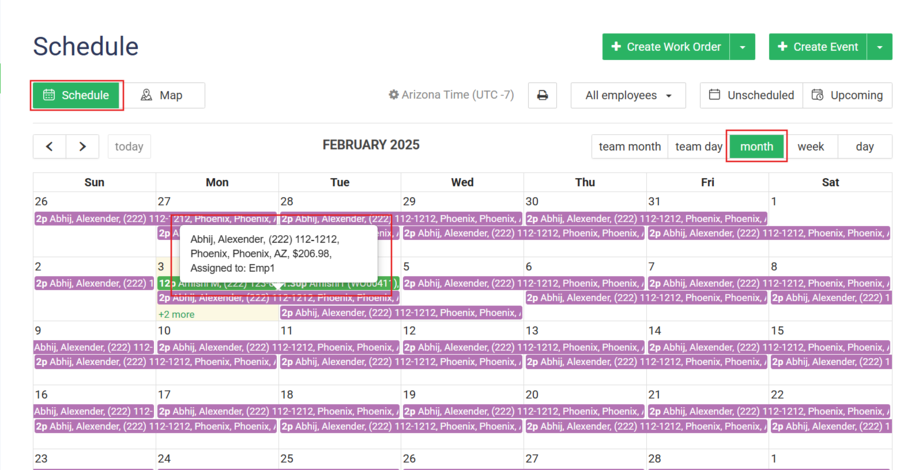
There are still important workflow boundaries. Markate’s work-order documentation says creating a change order is a desktop-only action, and its map tools should not automatically be equated with the adaptive capacity or optimization engines used by more complex dispatch systems. A buyer should reproduce a rescheduled job, a multi-day assignment, and a mid-job customer change during the trial rather than judge scheduling from an empty calendar alone.
Mobile App and Team Management
Field App and Offline Limits
The Markate app covers substantial day-to-day field activity, including access to schedules and job details, estimates and invoices, customer messages, photos, signatures, work status, mileage and expenses, routing context, and supported payment workflows.
Offline functionality is narrower than the app’s overall feature list. The current official pricing description specifically promises viewing schedules and work orders offline, followed by synchronization when connectivity returns. It does not establish that technicians can create and save new estimates, invoices, photos, signatures, or payments entirely offline. Any offline creation or editing that matters to the business should be verified in the current app before purchase.
Employee Roles and Permissions
Markate’s documented employee roles include Field Tech, Office Manager, Sales, Accountant, and Partner. They are not interchangeable: Field Tech has mobile-app access only, Accountant has web access only, and other roles can have different levels of access on both interfaces. The company explicitly warns that restricting a function in App Permissions does not automatically restrict Web Access.
That distinction is material for teams sharing customer pricing, payroll-related information, or financial reports. Low-priced additional seats are useful only if employees can perform their jobs with appropriate permissions and without being given unnecessary administrative access.
Estimates, Costs and Payments
Estimates to Work Orders and Invoices
Markate supports standard, option, and package estimates, allowing a contractor to present different scopes or price levels to the same customer. Approved work can move into a work order and eventually an invoice, while signatures, progressive or recurring work, and payment schedules support jobs that cannot be completed in one visit.
The documentation also distinguishes customer-approved changes from casual field edits. A technician finding extra damage may need the office to create a formal change order on desktop; the customer can then review and approve it through the shared link. Contractors who routinely encounter scope changes should verify this handoff with the people who will handle it, particularly when no one is stationed at a computer during the day.
Job Costing and Profitability
Job costing is a substantial feature for a product aimed at smaller contractors. Markate allows costs for items, labor, expenses, and overhead to be associated with individual work orders and reports the resulting job profit and margin. Its Academy describes a calculation based on job total less items, expenses, and labor, while the setup workflow also offers overhead entry. That makes the tool useful for comparing quoted work with the costs recorded after completion.

Markate’s job margin should be treated as operational tracking, not a substitute for accounting reconciliation, payroll calculations, or business-wide financial statements. Its main value is identifying which types of work deserve closer attention before the next estimate is written.
Payments and QuickBooks
Markate’s August 11, 2026 product update states that new users can connect Square or PayPal as their payment processor. The company’s feature descriptions also include online payments, invoicing, Square-related card-on-file and ACH options, and Wisetack financing. Because payment products and eligibility can vary by processor and account, confirm the available methods, transaction charges, and settlement workflow for the specific new account rather than assuming every feature applies across Square and PayPal.
The QuickBooks Online connector needs similarly precise reading. Markate documents QBO-to-Markate imports for customers, invoices, expenses, and estimates, as well as Markate-to-QBO exports for those record types. Its automatic sync guidance centers on exporting Markate records to QuickBooks; payments recorded in Markate can also be exported. Deleting a record in Markate does not delete its QuickBooks counterpart.
Before enabling auto-export, decide which system owns customer details and invoices, and test an edited invoice, partial payment, duplicate customer, and deletion. Markate’s own FAQ describes duplicate-resource and mapping errors with corresponding sync logs. One G2 review also raises accounting concerns, but individual complaints are better used as test cases than treated as evidence that all integrations fail.
Automation, Marketing and AI
Automation and Growth Add-Ons
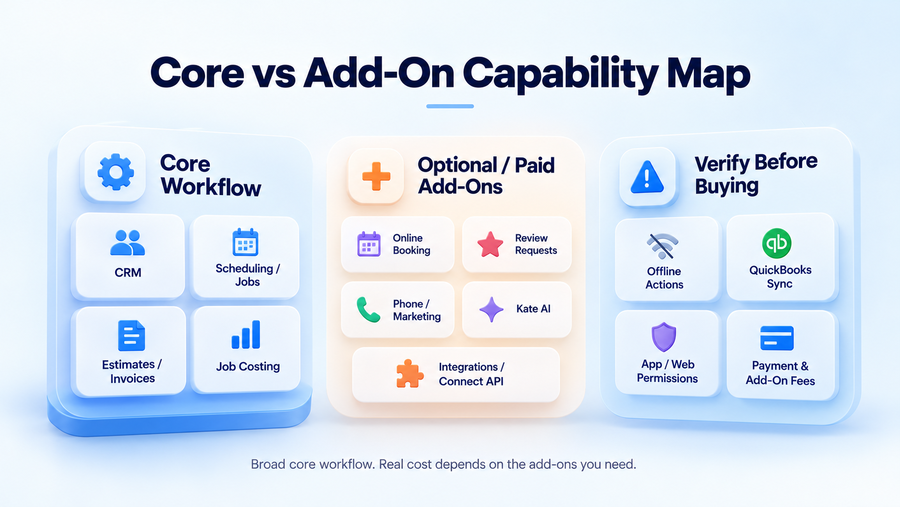
Markate includes useful operational automation around estimate follow-ups, customer reminders, job notifications, and invoice follow-ups. Separate products expand that workflow into online booking, automated review requests, a branded customer portal, business phone numbers, campaigns, and integrations with services such as CompanyCam, NiceJob, ResponsiBid, and Zapier. Several are individually billed monthly, while SMS campaigns and other outreach products can also carry usage charges.
A pressure-washing owner may value online booking but have no use for a branded portal or additional phone number. Another company may rely on recurring review requests, calls, and marketing messages and accumulate a much larger monthly stack.
Kate AI and 2026 Expansion
Markate’s 2026 development has materially expanded its AI offering. Kate AI Estimator launched in April with job-detail and photo-based draft estimating that draws on business pricing or catalog information. In June, Markate announced expanded Kate AI Receptionist support for scheduling, rescheduling, and dispatch; in September, it announced live AI Proposals. The June mobile release also added AI estimating entry points. These are current vendor-announced capabilities, although any claims about estimate accuracy, close rates, or time saved are Markate’s marketing assertions rather than independently established outcomes.
The estimator and receptionist also need their own cost and workflow checks. Markate describes its receptionist as usage-priced per call and markets AI estimation as a separate offering. An owner should test whether photo-based drafts require substantial correction, whether the business’s service prices are represented accurately, and what happens when the AI cannot confidently identify a job.
Markate also launched Connect API in 2026. It is a paid developer product, but its official terms and developer site make clear that access must be requested and approved. A subscription fee alone does not guarantee API credentials, specific endpoints, or permission for a proposed integration. Businesses planning a custom connection should obtain approval, confirm supported operations and limits, and validate the intended workflow before including API automation in their buying case.
Pricing, Add-Ons and Exit Terms
Base Subscription and Add-Ons
Markate uses an owner-operator subscription with a relatively small additional monthly charge for each active employee. The published model includes a 14-day trial without a credit card and monthly or prepaid annual billing. The official pricing page currently contains inconsistent representations of annual pricing or discount terms across its published surfaces, so an accurate purchase decision should rely on the amount shown at checkout and the written billing selection, not a calculated saving borrowed from an older page.
The low employee charge becomes attractive when several people need access to schedules, customers, or field jobs. A solo operator using core estimates, jobs, and invoices may have a much lighter bill than a team that automates lead capture, calls, review requests, and campaigns. Each business should price its actual configuration rather than multiplying the owner fee by the number of employees.
Cancellation and Data Access
Markate’s pricing FAQ describes month-to-month use without a long-term monthly commitment, alongside annual prepayment. Its Terms state that fees are generally nonrefundable, including partially used periods, and specify cancellation before the next billing date to avoid renewal charges. The pricing FAQ also explains that access stops if the subscription lapses. This is a reason to understand renewal timing and exports, not evidence that customers cannot cancel.
Before leaving, export the customer, estimate, work-order, invoice, and other records the business needs, checking CSV/PDF availability for each category. Markate’s account-deletion guidance recommends exporting data and disabling customer notifications and recurring work orders before closing the account. Its Terms assign customers responsibility for their own backups; any server-side retention for recovery should not be mistaken for continued subscriber access to a searchable archive.
What Markate Users Say
Ratings Snapshot
| Source | Rating | Sample shown | What it measures |
|---|---|---|---|
| Capterra | 4.2/5 | 10 reviews | Overall product experience |
| G2 | 4.8/5 | 3 reviews | Overall product experience; very small sample |
| Apple App Store | 4.1/5 | 166 ratings | iOS app experience |
| Google Play | 4.0/5 | 257 reviews | Android app experience; top-level listing |
Ten Capterra reviews and three G2 reviews provide limited evidence about the full desktop-and-mobile platform, while the larger app-store counts say more about day-to-day mobile experience. Google Play’s top-level listing also displays a device-specific panel with different figures, which should not be mixed with its headline number.

What Users Like
Positive public reviews repeatedly mention the amount of functionality available for the price, especially connected customer records, estimates, scheduling, invoicing, and communication. A June 2025 Capterra reviewer using Markate in a handyman business praised its organized notes, invoices, estimates, and business reports while objecting to accumulating add-on charges. A July 2025 Apple reviewer described a smoother customer-contact-to-payment process and helpful support interactions.
Support feedback deserves balance. Some Capterra and app-store reviewers report responsive staff who helped with onboarding or questions. Those reports are meaningful but cannot establish a universal support experience, especially given the small sample and the product’s ongoing changes.
What Users Dislike
Critical reviews raise mobile slowdowns or bugs, uneven support experiences, billing concerns, and occasional workflow or accounting problems. A June 2024 App Store reviewer reported slowness and communication limitations; a November 2025 Google Play reviewer complained about recurring-work/income discrepancies and difficulty obtaining help. A July 2024 Capterra reviewer criticized support and payment-processing options. These are dated individual experiences, not verified defects affecting every subscriber.
Later releases matter when interpreting older complaints: Markate documented mobile fixes in May and June 2026 and changed new-account payment-processor options in August. Neither change proves that all current field-app problems are solved. Markate’s published live-support window is Monday through Friday, 9 a.m.–5 p.m. MST, which may be restrictive for companies that run evening or weekend calls. Evaluate support response and the latest app build during the trial, and keep billing allegations separate from the actual cancellation and refund terms.
Who Markate Fits Best
Choose Markate When
Markate is a compelling option when the owner needs customer history, estimates, field work, job costs, invoicing, and follow-ups in one reasonably priced system. It is well suited to handyman, cleaning, painting, pressure-washing, landscaping, and similar service operations where work may be completed across several visits and office staff need visibility into what technicians have done.
Consider a crew returning to a rental property over several days. The office can locate the customer record and prior estimate, technicians can use the assigned work order and photo checklist, and the owner can account for added materials before invoicing. That connected workflow is Markate’s main selling point. The strongest match is a business comfortable with its documented offline limits and willing to add only the optional modules it actually needs.
Consider Alternatives When
Markate is less convincing when the operation requires advanced capacity-based dispatch, complex inventory governance, construction-project administration, strict multi-system accounting controls, or genuinely comprehensive offline editing and payments. It is also worth reconsidering if the current mobile build performs poorly on the devices and networks technicians actually use, or if the company relies on guaranteed live help outside Markate’s published hours.
A contractor needing a more governed dispatch or field-financial system should compare different workflow models, including options such as Jobber or Housecall Pro, without assuming that a higher price automatically solves the problem. An owner who needs many paid Markate marketing, phone, and integration modules should also compare the complete configured subscription, not just base prices.
If Jobber is also on your shortlist, read our Markate vs Jobber comparison for employee costs, paid add-ons, QuickBooks workflows, and cancellation terms.
Final Verdict
Markate delivers unusually broad operational coverage for a small-service platform with a low incremental employee charge. Its biggest value comes from keeping customer information, estimates, work orders, field updates, invoicing, and payments connected throughout a job, supported by job costing and selective communication automation. The 2026 AI, proposal, mobile, payment, and API announcements make older feature-only reviews increasingly incomplete.
The purchase decision becomes less clear when the company needs numerous paid add-ons, dependable offline editing, complex accounting synchronization, or support outside normal business hours. Public reviews contain both strong praise and credible frustrations, while the full-product review samples remain small.
Use the 14-day no-card trial to run one representative job from estimate through approval, work order, technician update, invoice, and payment. Check mobile performance on actual employee phones, test app and desktop role permissions, compare cost after required add-ons, and reconcile a sample invoice and payment in QuickBooks Online. If those workflows work cleanly and the team does not need deeper specialized controls, Markate can offer strong value without a large per-user software bill.