

Last updated: November 2026
On this page
Markate costs $49.95 per month for an Owner Operator account, with an additional $5 per month for each active employee on regular monthly billing. Customer management, estimates, scheduling, work orders and invoicing sit within the core platform. Online booking, a branded customer portal, certain marketing tools and other optional capabilities can increase the bill.
For a five-person operation consisting of the owner and four active employees, that produces a $69.95 monthly base subscription before add-ons. The annual offer deserves an extra check: Markate’s official pricing has shown conflicting yearly figures in separate observations, even though its current public page displays a lower annual-equivalent rate. This guide explains the reproducible monthly costs, what employees can actually access, which features carry separate charges and what happens when you cancel.
Markate Pricing at a Glance
Markate’s pricing revolves around an owner subscription and additional employee access. The Team presentation is the owner base plus paid employee accounts, rather than a second, unrelated full-priced subscription that every worker must purchase. The owner is already one person in your team count. A shop with three people therefore pays for two additional active employees, not three.
Markate does not list a permanent free plan. It offers a 14-day trial without a credit card, but access to every paid module after the trial is a separate question. Its pricing page groups core operations alongside optional products; a feature’s appearance on that page does not always mean it is included in the base fee.
What Is Included in the Price?
| Cost component | Monthly reference | What it buys or what to check |
|---|---|---|
| Owner Operator | $49.95 | Main account; core service-business workflow |
| Additional active employee | $5 per employee | Role-dependent app and/or web access; owner already counted |
| Core CRM, estimates, schedule and invoices | Included in base listing | Routine records and work management; payment processing is separate |
| Online Booking | +$10 | Optional customer booking capability |
| Branded Customer Portal | +$10 | Optional branded customer-facing portal |
| Zapier integration | +$10 | Markate connection; third-party costs may still apply |
| Connect API | +$50 | Paid developer access, subject to approval |
| Kate AI Receptionist | $1 per qualifying call | Usage-based; published short-call exclusions and duration rules apply |
| Annual owner subscription | Confirm at checkout | Conflicting official yearly observations; annual add-ons have separate billing implications |
These are published reference charges, not a complete quote. Employee permissions, processing fees, usage and third-party subscriptions affect the total.
Monthly vs Annual Billing
What the Monthly Price Includes
The simplest way to budget is to start with the regular $49.95 month-to-month Owner Operator charge. Add $5 for each additional active paid employee and then include only the optional features you intend to enable. The monthly model is useful when staff counts or required modules may change, since it avoids committing the entire owner subscription amount for a year in advance.
An owner with two active employees can budget $59.95 for base subscription access. This excludes taxes, processing, QuickBooks Online and paid messaging; it also does not guarantee identical desktop permissions for those employees.
Why the Annual Price Needs Verification
The current public Markate pricing page displays an Owner Operator annual equivalent of $45.95 per month, billed as one $551.40 payment, with an advertised 8% saving. Its current FAQ presents the same annual figure. Separate retrieved versions of Markate’s official pricing have also shown $39.95 per month, or $479.40 paid yearly, with a 20% saving. Home Service Fit’s working pricing dataset retains both observations and flags the discrepancy rather than choosing a definitive checkout offer from a cached or differently rendered page.
The $45.95 figure is the currently visible public reference, but confirm the Pay Yearly selection and final payment amount before purchasing. An offer shown in a search result, an older comparison or even a pricing-page capture may not match the active account checkout. Ask Markate to clarify which rate renews, whether it applies to a new signup, and when any price change takes effect.
Annual billing also introduces a second uncertainty for teams. Markate’s FAQ says annual members are billed annually for add-on features. It does not, by itself, establish exactly how a newly hired or deactivated employee changes a prepaid bill during the year. The older employee refund policy contains historical rules, but those should not substitute for a current account-level confirmation. Accordingly, the annual totals for three- and five-person teams are not estimated here.
Employee Seats and Access Rules
The $5 Per-Employee Calculation
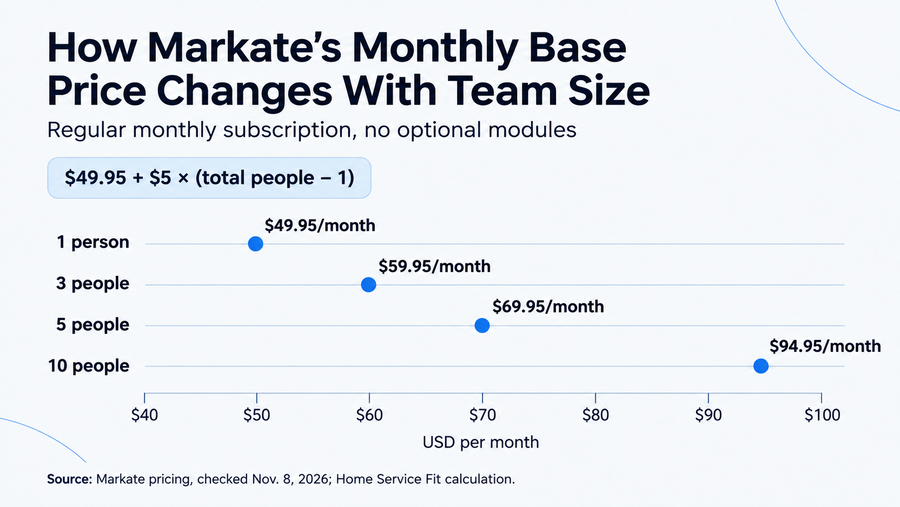
The additional employee charge is relatively easy to model on monthly billing. Use $49.95 + $5 × (total people − 1), assuming the first person is the owner, every other person is an active paid employee, and no optional modules are selected. With three people, the two extra accounts cost $10; with five people, four cost $20. A ten-person example would add nine accounts for a $94.95 base month.
The word active matters. Markate says inactive employees are not charged, and its employee instructions describe retaining their history while disabling access. However, the date a change affects billing, the treatment of already-paid seats and any annual adjustment should be confirmed in the account before assuming an immediate credit. These figures are also an access-cost model, not a payroll estimate: a field worker’s wages or contractor charges are completely separate.
Roles and Permission Differences
A $5 employee login is not another unrestricted owner account. Markate distinguishes Field Tech access through the mobile app from Accountant access through the web interface. An Office Manager can use the app and limited web modules, Sales has app and web access with defined scope, and Partner generally has broader access. App permissions and web permissions are administered separately, so hiding a function in the app does not necessarily hide it on desktop.
Consider a solo handyman who brings on a field technician to view assigned work, record time and update job information. The Field Tech role may suit that workflow. Hiring an office coordinator is a different decision: before paying for the login, the owner should check whether the selected role can edit customer records, prepare invoices, change appointments and view the reports the job requires. The same subscription price does not guarantee the same set of controls.
What Costs Extra in Markate?
Fixed Monthly Add-Ons
The platform includes day-to-day service management, but several customer-facing capabilities are sold as selectable modules. Online Booking ($10 per month) makes sense when homeowners should request appointments from a website. A Lead Contact Form ($10) can capture inquiries without the same booking workflow. A branded Customer Portal ($10) serves a different purpose: giving existing customers a recognizable place to access account or service information. An owner may need one of these features, several, or none.
Other published $10 monthly options cover automated review requests, Zapier, CompanyCam integration, a virtual business number and selected communication or proposal tools. These names should not be treated as interchangeable. Connecting CompanyCam can involve paying for CompanyCam itself; enabling a Markate connection is not a subscription to every third-party product on the other end. The same distinction applies to workflows that depend on external phone or automation services.
Markate also lists Connect API and Developer Access at $50 per month, but it is an approval-based product rather than an unrestricted switch included with every account. A business wanting a custom integration should confirm approval, data permissions and its own development costs before budgeting around it. The account’s Additional Features screen is the appropriate place to inspect the available module, monthly charge and eligibility for the specific subscription.
Usage-Based Messaging and AI
Some costs rise with activity instead of remaining a fixed monthly amount. Markate lists Kate AI Receptionist at $1 per qualifying call, with the dedicated product FAQ describing calls up to five minutes and exclusions for calls shorter than 30 seconds or filtered spam calls. An additional-features help page uses inconsistent wording about this price; the dedicated Kate guidance and pricing page more clearly describe a per-call charge. Owners with frequent inbound calls should verify how longer calls, transfer behavior and qualifying calls appear on their actual billing statement before forecasting usage.
Published marketing charges include automated SMS drips at $0.10 per SMS, SMS blasts at $10 setup plus $0.05 per segment, and email blasts at $10 for 2,000 emails. These usage fees are separate from monthly modules; confirm volume, segments and phone-service charges.
Three Practical Markate Configurations
| Example operation | Selected optional features | Illustrative monthly subscription | Excluded from the estimate |
|---|---|---|---|
| Solo owner | None; core features only | $49.95 | Usage, processing, tax and outside services |
| Owner + 2 active employees | Online Booking ($10) | $69.95 | Other add-ons and variable charges |
| Owner + 4 active employees | Online Booking, branded portal and review requests ($30 total) | $99.95 | Other add-ons and variable charges |
Each figure uses the regular $49.95 monthly owner subscription, $5 for every additional active employee and only the named modules. The middle example is $49.95 + $10 in employee charges + $10 for booking; the five-person example is $49.95 + $20 + $30. These are Home Service Fit calculations from published pricing inputs checked November 8, 2026, not surveyed customer invoices or all-in quotes. Employee access varies by role, and monthly examples cannot be converted into guaranteed annual offers by multiplying indiscriminately.
Included Workflow Features and Limits
Markate’s core listing covers customer and lead records, estimates, scheduling, work orders, invoicing, expenses, job costing and related reports. That is enough for a handyman to maintain a connected record of a repair: the customer’s request, the proposed scope, the assigned visit, any added materials and the final invoice can remain associated with the job. Features such as recurring work orders and change-order approvals are also described in Markate’s work-management materials.
Routine work may fit the base plan, but promised online self-booking requires the relevant paid module. The full Markate review explores product strengths and operational limits beyond subscription arithmetic.
QuickBooks Online illustrates another distinction between an included connector and the cost of using it. Markate’s integration listing and help documents say the connector itself carries no additional Markate fee, but the business still needs its own QuickBooks Online subscription. Markate supports manual imports of customers, invoices, expenses and estimates from QBO and manual exports of corresponding records to QBO. Its ongoing Auto Sync instructions are primarily Markate-to-QBO exports. Do not assume every edit made in either product flows continuously in both directions; payment handling, duplicates and deleted records need specific reconciliation checks.
Payment Fees and Outside Services
Accepting a customer’s card payment creates a cost category separate from Markate’s subscription. The pricing page describes payment connections and methods, including Square, but does not establish one universal card or ACH processing rate for every merchant and transaction. The amount depends on the actual processor agreement, payment channel and services selected. Instant payouts, refunds and chargebacks can carry their own conditions.
A similar distinction applies to a business using QuickBooks Online, CompanyCam or a third-party phone service. The Markate module may be $10, free or already listed in the base plan while the external product has its own bill. An owner comparing software expenses should write down both charges rather than treating an integration label as evidence that the connected service is supplied at no additional cost.
Markate advertises data-migration assistance and a short estimated timeline, but neither is guaranteed for a particular business. Confirm which records, photos and recurring-job settings will transfer, and who must prepare the old data.
Trials, Cancellation, and Renewal
Trial and Billing Start
Markate advertises a 14-day free trial with no credit card required at signup. Its pricing FAQ describes full feature access, while its current Additional Features documentation makes a narrower distinction: some add-ons can be used during the trial, and others may require a paid plan or incur separate charges. These statements should not be combined into a promise that every paid service or usage-based product is free and active throughout the entire trial.
If online booking, the customer portal, Kate or an integration will determine the purchase, check that feature inside the actual trial account and ask what is included in testing. Record the post-trial price before enabling anything that needs payment information. The trial itself does not require a card, but paid subscription billing starts when the owner selects and pays for an eligible plan; continuation after the trial may require valid billing details.
The most useful trial is a real task: enter a customer, produce an estimate, create a work order, assign it to a worker with the intended role and issue an invoice. Then inspect any add-on the business would genuinely purchase. This reveals practical permission or feature-gate issues before a larger annual commitment.
Auto-Renewal, Refunds, and Exit
Markate markets flexible subscriptions, but the current Terms and Conditions describe both monthly and annual automatic renewal. Paid subscription amounts are generally nonrefundable, including unused portions of the billing period. The terms state that cancellation should be completed through the account at least one day before the next billing date; access normally continues through the paid period after cancellation.
The pricing FAQ also mentions contacting support or allowing a payment to lapse. The account-based procedure in the terms is the safer contractual baseline. An unpaid invoice can remain an obligation under the terms, and deliberately letting a payment fail is not a substitute for documented cancellation. Save the cancellation confirmation and the next billing date, especially if a staff reduction or migration is happening at the same time.
Annual prepayment changes the amount at risk even when a vendor says there is no long-term contract. An owner who stops using the software after several months should not assume the remaining prepaid period will be refunded. Before leaving, export essential records in the available CSV or PDF formats, inspect the files and confirm access to invoices, payment history and job attachments. Markate’s FAQ warns that a lapsed account may lose platform access; it does not promise a universal post-cancellation export window.
Is Markate Worth the Cost?
Good Fit for a Lean Service Team
Markate can be worth evaluating for an owner who wants to keep estimates, appointments, invoices, customer history and job expenses in one relatively low-cost service-business system. The marginal $5 employee charge is especially relevant when the owner needs field technicians to see assignments without buying a separate full-priced owner subscription for each person. For a basic three-person operation, the published $59.95 base month provides an understandable starting budget.
When the Add-On Model Becomes Costly
The economics become less obvious when the business relies on online booking, a branded portal, lead forms, review automation, phone tools and external integrations together. Each choice may be reasonable, yet the total rises with modules and usage. A contractor receiving many inquiries may value Kate or an automated contact form, but that decision needs call-volume and conversion evidence from the business itself rather than a vendor’s promotional claims.
This is also the point where a different packaged product may deserve evaluation. The Markate vs Jobber comparison examines how Markate’s individually priced modules contrast with Jobber’s plan-based features. The relevant comparison is between complete setups that perform the same required tasks, including employee permissions, customer communication and accounting, rather than two headline starting prices.
Questions to Check Before Buying
Before choosing a billing option, make a short purchase worksheet using the actual account and work the business will run:
- Confirm the annual checkout. Record the selected rate, payment due, renewal date and whether the annual price is available to your account.
- Count active employees correctly. Include the owner once, assign the real staff roles and verify which web or mobile actions each person can perform.
- Price the required modules. Turn on only the booking, portal, review, communication or integration options you will use; check when charges begin.
- Check variable and outside charges. Ask how Kate calls and marketing messages are billed, which processor fees apply and what third-party subscriptions remain necessary.
- Test the exit. Confirm employee-removal billing, annual add-on adjustments, cancellation steps and the records available for export.
Final Pricing Verdict
Markate’s reproducible starting point is $49.95 per month for the owner plus $5 for every additional active employee. On that basis, an owner with two active employees costs $59.95 monthly before optional features, while an owner with four costs $69.95. The platform offers substantial everyday job-management capability at that base level; optional booking, customer portal, marketing, phone and integration functions determine how much higher the useful configuration becomes.
The annual listing currently visible publicly is $45.95 per month equivalent with a $551.40 prepayment, but conflicting official observations make checkout verification important. Employee-role limits and annual add-on billing also deserve more attention than a simple per-user multiplication.
Select the smallest configuration that supports real office and field work, verify the full bill, and retain the checkout terms. Test that configuration before prepaying for a year.